
-815x800.jpg "Silicone mold, Balloons, ~ 5.2*6 cm, H:2.2 cm")
-815x800.jpg "Silicone mold, Balloons, ~ 5.2*6 cm, H:2.2 cm")
-815x800.jpg "Silicone mold, Balloons, ~ 5.2*6 cm, H:2.2 cm")
-815x800.jpg "Silicone mold, Balloons, ~ 5.2*6 cm, H:2.2 cm")
-815x800.jpg "Silicone mold, Balloons, ~ 5.2*6 cm, H:2.2 cm")
-815x800.jpg "Silicone mold, Balloons, ~ 5.2*6 cm, H:2.2 cm")
-815x800.jpg "Silicone mold, Balloons, ~ 5.2*6 cm, H:2.2 cm")

Silicone mold, Balloons, ~ 5.2*6 cm, H:2.2 cm
Silicone mold, Balloons, ~ 5.2*6 cm, H:2.2 cm
- Brand: DekoPasaule
- Weight: 105g
- Availability: 996
-
23.40€
Barcode: 4752262012517
SKU: 4001110250053
ℹ️ YouTube tutorials on our YouTube channel
ℹ️ youtube.com/@PolymerClayLatvia
ℹ️ Production & materials
We cast our molds by hand after your order.
⏳ Production time: up to 5 business days, depending on the order queue.
⏳ For bulk orders, production time may be longer.
✔️ We use high-quality Italian non-toxic platinum-cure silicone.
✔️ All silicone molds are heat resistant from -40°C to +200°C (104°F to 392°F).
✔️ Different materials and mold shapes require different silicone hardness.
This is especially important for deep molds, thin details, and fragile materials such as wax or soap.
⚠️ Important information for soy or palm wax
Please read this carefully if you work with soy or palm wax.
Soy wax and palm wax are significantly more fragile than many other types of wax.
Silicone molds with very thin and delicate details (succulents, petals, fine leaves) may be extremely difficult or even impossible to demold without breaking, even when using the softest silicone.
✔️ Simple and less detailed shapes can often be successfully demolded even from firmer silicone.
ℹ️ See my experiments with soy wax and other types of wax: youtu.be/VFenJlyH0JY
ℹ️ How to choose the right silicone hardness
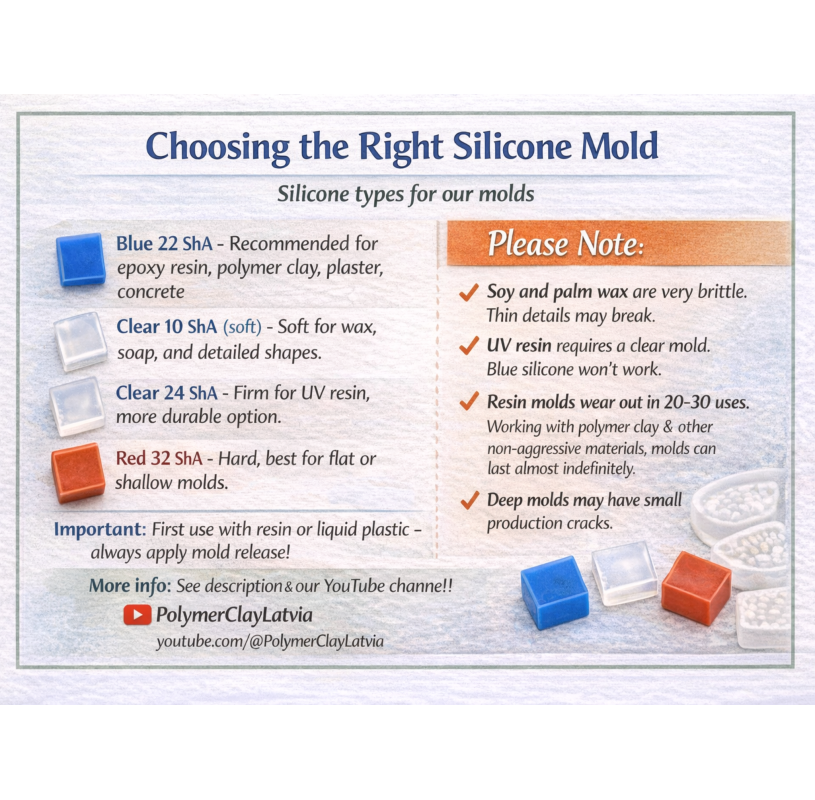
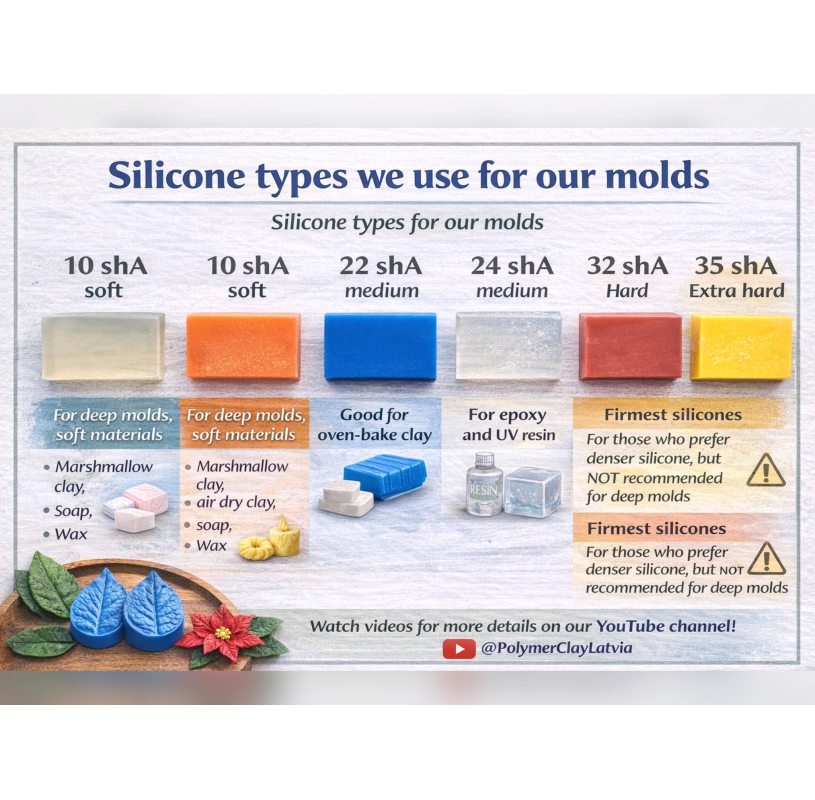
⚠️ 1. Blue silicone — 22 ShA
✔️ Suitable for: polymer clay, epoxy resin, gypsum, plaster, concrete
✔️ Best for shallow and medium-depth molds
⚠️ Wax & soap — only for simple, shallow shapes
⚠️ Not recommended for deep molds with thin or delicate elements when using wax or soap
❌ Not suitable for UV resin (UV light does not pass through colored silicone)
⚠️ 2. Transparent silicone — 10 ShA (soft)
✔️ Best choice for wax, soap, deep and highly detailed molds
✔️ Also suitable for: natural clay, self-hardening clays, marshmallow clay
✔️ Soft silicone allows easier demolding of fragile materials and thin elements
✔️ Rule of thumb: the softer the material, the softer the silicone should be
✔️ For polymer clay and soft clays, freeze the mold for 5–10 minutes before demolding
✔️ Transparency allows you to see air bubbles when working with liquid materials
ℹ️ If a listing is offered only in transparent silicone, the mold is made in 10 ShA by default, as this hardness is most suitable for its shape and depth.
⚠️ 3. Transparent silicone — 24 ShA
✔️ Recommended mainly for UV resin
✔️ Transparency allows UV light to pass through and fully cure the material
✔️ Slightly firmer than blue silicone and much denser than 10 ShA
✔️ Better shape stability and longer service life than 10 ShA
✔️ Suitable for makers who prefer denser silicone while keeping transparency
⚠️ 4. Orange silicone — 10 ShA (soft)
✔️ Same softness and flexibility as transparent 10 ShA
✔️ Color difference only
✔️ Recommended for large, deep or complex molds
✔️ Ideal for wax, soap, marshmallow clay and other soft air-dry clays
⚠️ 5. Red (terracotta) silicone — 32 ShA
✔️ Firm silicone for flat or shallow molds
✔️ Helps the mold keep its shape during filling
⚠️ Softer silicone may slightly expand, resulting in a slightly larger finished piece
✔️ More durable for aggressive materials such as RESIN
⚠️ Important information for resin & two-component plastics
✔️ Silicone is a porous material and becomes impregnated with the material used over time.
In rare cases, when using a mold for the first time with epoxy resin or liquid two-component plastic, the material may bond to the silicone if no mold release is used, causing permanent damage.
✔️ Applies mainly to epoxy resin and liquid plastics
✔️ UV resin is usually less aggressive, but mold release is still recommended for first use
✔️ To avoid damage:
Before first casting, treat the mold with a proper mold release or pre-condition it with a thin layer of petroleum jelly.
This fills the silicone pores and prevents sticking. After conditioning, the mold can be cleaned before use.
⏳ Durability
✔️ RESIN molds last about 20–30 uses, depending on material aggressiveness
⚠️ After that, silicone may lose properties and tear
✔️ With non-aggressive materials (polymer clay, air-dry clay), mold life is almost endless
⚠️ Tips for polymer clay
✔️ For deep molds, polymer clay can be baked directly in the silicone mold
✔️ Silicone withstands temperatures up to 200°C (392°F)
⚠️ Always follow the baking temperature instructions of your clay manufacturer
✔️ Freezing the mold for 5–20 minutes makes demolding easier
✔️ Especially effective for berry molds
✔️ Thin shapes can often be removed by gently folding the mold
ℹ️ About deep molds & small cracks
On deep molds (cucumbers, popcorn, succulents, some vegetables), small cracks may appear on a new mold.
This is due to production specifics and is considered normal.
✔️ Does not affect functionality or durability
✔️ A small line may appear on the finished piece
✔️ In some cases, these cracks make demolding easier
ℹ️ More videos and tutorials can be found on our YouTube channel PolymerClayLatvia
Tags: polymer clay tools, polymer clay shapes, silicone mold, art supply, jewelry making, modeling tool, forming shape, handmade mold, soup making tool, silicone shape, resin making tool, mold for wax, balloons, birthday party